
An engagement can turn a joyful question into a dozen practical ones: What kind of celebration do we want? How many people might come? What should we spend first? Do we need a venue before we choose a date? If you are wondering where to start wedding planning, you do not need a perfect vision or a complete checklist today. You need a shared starting point that helps the next decision become easier.
Begin with one focused conversation, then write down what you know, what you are estimating, and what still needs an answer. That small distinction can keep early ideas from turning into accidental promises. By the end of this guide, you will have a simple way to align as a couple, choose the right first investigation, and keep the first week of planning manageable.

Start with one focused conversation, not a full wedding vision
Before opening a venue directory or saving another inspiration board, set aside about an hour to talk together. Choose a time when neither of you is rushing to another commitment. Bring a notebook or one shared document. The goal is not to settle every detail. It is to understand what each person hopes the celebration will feel like and what practical limits should guide the next round of research.
Start with a few open prompts. What do you most want to remember about the day? When you picture the people you love together, what are they doing? Which moments matter most to you: a meaningful ceremony, a long dinner, dancing, time with family, or something else? What would make the day feel unlike you? Give each person time to answer without immediately turning preferences into purchases or logistics.
Then compare answers and look for shared themes. One partner might care most about an unhurried meal, while the other imagines a lively dance floor. Those ideas can fit together, but they suggest different choices about the schedule and space. Write down the common thread first, such as “we want guests to have time to connect,” before deciding what that means in practice.
Use this short agenda to keep the conversation useful:
- Each person names three things that would make the celebration feel meaningful.
- Each person names one thing they feel comfortable keeping simple or skipping.
- Discuss a rough guest range, not a finished invitation list.
- Talk about the amount you can spend comfortably and whether anyone else may contribute.
- List date, season, or location preferences as flexible, preferred, or essential.
- Write down disagreements and questions without trying to solve them all in the room.
End by agreeing on a brief summary, not a design concept. For example: “We are planning an evening celebration for roughly 70 to 90 guests, within a comfortable total spending range, in a location reachable for our closest family. Dinner together matters most; the date can be flexible.” A sentence like this is specific enough to guide research but open enough to change when you learn more.
If one person is ready to book and the other is still processing the engagement, agree on a small pause. You can set a date for the next planning conversation without making a contract decision today. A shared pace is part of the plan. It is easier to make confident choices when both partners know what is being decided and why.

Agree on the guardrails that shape every next choice
A good starting brief separates firm boundaries from temporary estimates. If every idea is treated as final, the planning process can feel restrictive before you have learned what options exist. If nothing is written down, each conversation can begin from scratch. Use three labels: decided, working estimate, and open question.
Decided means you have talked it through and are willing to use it as a real boundary for now. Perhaps you know that you want a local celebration or that a particular person must be present. Working estimate means you are using a reasonable placeholder to research the next choice, but you expect it may change. A guest range belongs here until you have reviewed names together. Open question means you need information or another conversation before choosing.
Keep the first brief small. It can fit on one page and include five areas:
- Feeling and priorities: three qualities you hope the day will have and the two details that matter most.
- Guest range: a low and high estimate that helps you assess possible spaces.
- Spending comfort: a range or ceiling that reflects what you can responsibly commit, not a figure borrowed from someone else’s wedding.
- Date and place flexibility: the seasons, weekdays, travel radius, or location types you would consider.
- People and input: who needs to be part of key conversations, including anyone who may contribute money or practical support.
Money conversations deserve care because a contribution can come with assumptions. Before counting a possible gift as part of the plan, ask the person offering support what amount they have in mind, when it would be available, and whether they have expectations about how it is used. You and your partner can listen respectfully and still decide which choices belong to you. If an offer is uncertain, leave it outside the working budget until the details are clear.
For your own spending boundary, focus first on what you can afford without relying on best-case guesses. If you do not know the final number yet, record what you know and assign a next action, such as reviewing savings, discussing a contribution, or deciding how much monthly saving feels reasonable. This is only an initial guardrail, not a full category-by-category budget. A dedicated budget setup can come after the couple agrees on the broad shape of the event.
Likewise, do not force a precise guest count before you have looked at the people who matter. Make a rough range and note whose input could affect it. The range is useful because it helps you compare spaces and understand the scale of the event. It is not a reason to invite or exclude someone before you and your partner have talked through your priorities.
Put an owner and review date beside every open question. “Ask our families about possible contributions” is easier to act on than “figure out money.” “Compare travel needs for our closest relatives” gives the location discussion a concrete next step. Your one-page brief should make uncertainty visible while keeping it from spreading through every decision.

Choose the next decision by dependency, not by excitement
There is no universal rule that every couple must make the same first choice. The useful question is: which unknown is preventing the next meaningful choice? Start with the decision that unlocks the most other decisions while staying within the boundaries you have already discussed.
For many couples, the guest range and spending comfort work together. A venue that fits 50 people may not fit a plan for 140, and a space that looks affordable at first may include requirements that change the total commitment. You do not need to know every vendor cost before researching. You do need enough of a range to avoid comparing options that cannot work for your likely event.
Try a three-question filter whenever an idea or task appears:
- What choice depends on this? Identify the next decision it could unlock.
- What do we need to know to compare options? Name the missing information, such as capacity, access, total cost, or availability.
- What is the smallest useful action? Choose one call, conversation, or comparison rather than launching a broad research project.
Imagine you are drawn to an outdoor ceremony. Before collecting dozens of photographs, ask what conditions would make an outdoor setting work for you: a covered backup area, a nearby indoor option, accessible paths, or a particular kind of atmosphere. Those requirements can guide a short list of spaces. The point is not to predict every possible problem. It is to learn which practical questions matter to your decision.
When you compare venues, record the same information for each option so that a beautiful first impression does not become the only measure. Note the available date range, comfortable guest capacity, what is included, what you would need to arrange separately, and any questions you need answered in writing. Do not assume that a photograph or a brief listing gives you the complete picture. A site visit and clear questions may be useful once an option fits your basic boundaries.
If you are unsure whether to speak with a planner before venues, consider what kind of help would make the next decision easier. A planner may help you understand the planning scope, compare options, or coordinate a complex set of needs. If you are comfortable doing research together and have a straightforward event, you may prefer to gather a few facts first. Either way, the decision should follow your needs and budget, not a feeling that there is one correct order for every couple.
Keep inspiration in a separate place from decisions. Save an image with a short note about what you like: the candlelit atmosphere, the long family-style table, or the garden setting. Later, use those notes to identify a pattern. A large collection of saved images can show preferences, but it cannot tell you whether a space fits your guest range or whether the overall plan feels comfortable.
Make your first seven days useful and deliberately small
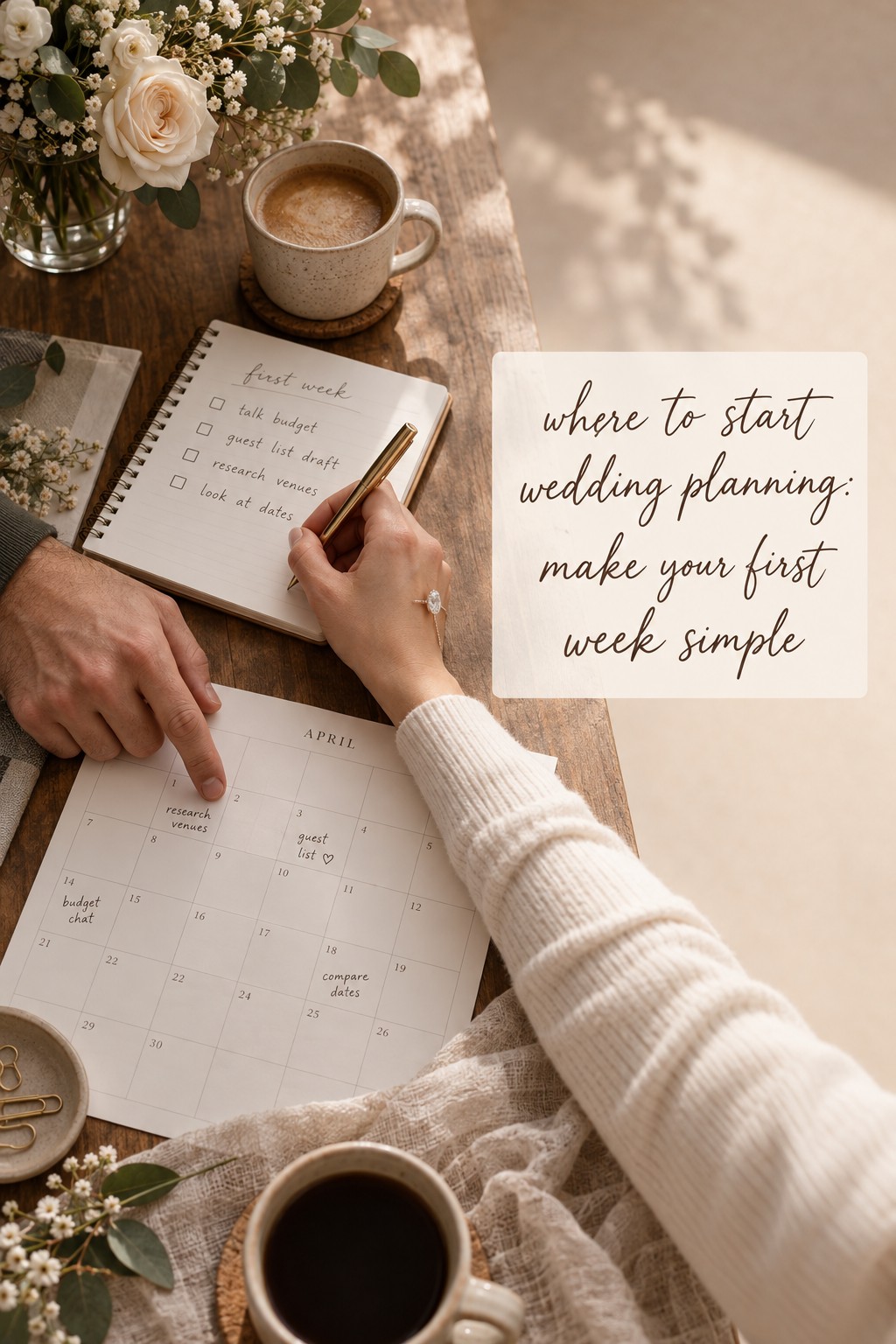
The first week does not need to be a sprint. Give each action a purpose and a stopping point. A few good conversations can prevent hours of browsing that produces more options but no clarity.
Day one or two: write the brief together. Capture your priorities, guest range, spending boundary, flexibility, contributors, and open questions. Read it aloud to check that it sounds fair to both of you. Keep it easy to edit. If you use a shared digital document, confirm that each partner can find and update the current version.
Day two or three: check the assumptions that could change your options. Talk with anyone whose availability or contribution matters to your decisions. You are gathering information, not asking someone else to design the wedding. If a conversation is sensitive, agree on who will start it and what you need to learn. Record the answer in the brief and avoid treating a possibility as confirmed before it is.
Day three or four: choose one research question. You might want to learn which nearby venue types can comfortably host your guest range, whether a meaningful location has practical access, or what different spaces include. Set a limit, such as reviewing a handful of relevant options and writing down the same comparison points. This is enough to identify what you need to ask next without creating a sprawling spreadsheet prematurely.
Day four or five: decide how you will track active decisions. Start with the simplest format you will both actually check: a shared note, a spreadsheet, a calendar, or a planning platform you already use. At this stage, it only needs to show the question, the current answer, who owns the next action, and when you will revisit it. You can build a fuller planning system when you know what records you need to manage.
Before the week ends: choose three next actions. Each action should have one owner and a date. For example, one partner can ask a contributor for clarity, the other can shortlist spaces that fit the guest range, and both can meet for 20 minutes to compare what they learned. Keep the rest of the idea list for later.
At the review, ask what changed. Did an answer narrow your location choices? Did you learn that a guest estimate needs another conversation? Did the spending range feel grounded, or do you need to revisit it? Update the brief and choose the next dependency. If nothing needs a decision yet, it is fine to stop and return to planning at the agreed time.
A lightweight planning resource such as The Wedding Command Center can be a useful place to keep a shared starting brief and return to decisions as the plan develops. Use any tool only if it makes the next step easier to see. You do not need to configure every feature or move every note before you know what the two of you want to plan.
Decide whether to bring in a planner before the task list grows
There is no single planning arrangement that works for every couple. Some want a professional to guide the full process. Others want help at a few important points, or support coordinating the event itself. Some prefer to plan independently. Consider the complexity of your plans, the time you can give them, your comfort with vendor conversations, and the amount you can set aside for support.
A planner conversation may be useful early if you have competing priorities, multiple locations, a destination, a compressed planning window, accessibility considerations that require careful coordination, or simply want help deciding what kind of celebration is workable. Those are reasons to ask questions, not proof that you must hire someone. You can learn about services and fees before deciding whether there is a fit.
Before an introductory call, write down what you hope the person will help you accomplish. Ask how their support is structured, what is included and excluded, how communication works, what decisions remain yours, and how fees and payment timing are explained in a contract. If you only need advice on priorities and a short list of next steps, ask whether that type of consultation is available. Compare the answers with your budget and expectations.
If you are not ready to choose, create a decision date. For example, agree to revisit planner support after you understand your guest range and location options. That prevents the question from lingering in every conversation while preserving the option to ask for help later. The right starting point is the one that helps you make the next choice with enough information and without adding unnecessary pressure.
Mistakes that make the beginning feel harder
Trying to agree on every detail before exploring anything. You can start with priorities and boundaries without choosing colors, flowers, attire, music, and a full schedule. Separate the big questions that affect feasibility from creative decisions you can revisit later.
Calling an estimate a decision. A rough guest count, possible gift, or preferred season is not a promise. Label it honestly, write down what could change it, and choose when to confirm it.
Letting one person’s excitement set the pace. A partner who has already saved ideas may be ready to compare vendors, while the other still needs time to talk about the kind of event they want. Agree on a next conversation and one small shared task so that both people remain part of the process.
Researching options without a decision filter. Browsing is useful when you know what you are trying to learn. Before opening another list, write one question and a stopping point. If a result does not help answer that question, save it for later.
Choosing a tool before choosing the process. A platform can collect information, but it cannot decide which priorities matter or how the couple wants to handle family input. Start with a simple shared note. Add structure when you can name what needs to be tracked.
Assuming there is a deadline for every idea. Some choices depend on other choices, and some can wait. Ask what must be known next and what can stay on the open-question list. A clear dependency is more useful than a long list that makes every task look urgent.
Making a booking because it looks perfect online. Before signing, understand the agreement, what is included, the dates and payment obligations, the practical fit for your guests, and any questions that matter to your plans. If something is unclear, ask for clarification and review the written terms. Do not let urgency replace understanding.
Wedding planning often feels more manageable when the couple can see the current answer and the next action in one place. Begin with a conversation, give uncertainty a label, and revisit the brief as new information arrives. Your first goal is not a finished wedding plan. It is a next step that both of you understand and are ready to take.
Sources and methodology
This guide was prepared after reviewing ten US search results covering first steps, planning checklists, tools, and newly engaged advice. The recommendations here are an editorial synthesis for the first planning conversation, not a report of personal testing or professional wedding-planning experience. For examples of common early prompts, see WeddingWire’s first five planning steps and Here Comes The Guide’s newly engaged guide.

FAQ
What is the first thing to do when you start wedding planning?
Have a focused conversation about the kind of celebration you want, your priorities, approximate guest range, spending comfort, and date or location flexibility. Write down what is decided, what is an estimate, and what needs another conversation.
Should we set a budget or make a guest list first?
Discuss them together as early planning boundaries. You can create a rough guest range and a comfortable spending limit at the same time, then refine both as you learn more. Neither needs to be a final number before you begin careful research.
Do we need to pick a wedding date before looking at venues?
You can research with a preferred season or a few possible dates in mind. A specific date may depend on venue availability and your flexibility, so treat early dates as preferences until you have checked the options and made a decision together.
How much of the guest list should we decide at the beginning?
A low and high estimate is often enough to guide early venue research. Make a full list later, after you and your partner have discussed the celebration you want and any family input that matters to you.
Should we hire a wedding planner before booking a venue?
It depends on the help you want, the complexity of your plans, your time, and your budget. You can speak with planners before booking to understand their services and fees, then decide whether that support fits your needs.
What if our families have different ideas about the wedding?
Start by agreeing as a couple on your priorities and who needs to be included in specific decisions. Listen to family preferences with care, clarify any offered contribution and related expectations, and decide together which choices you will make as a couple.
What can wait until after we have a starting plan?
Many detailed choices can wait, including most décor, stationery wording, favors, and the exact day-of schedule. Focus first on the questions that affect feasibility, such as priorities, a workable guest range, spending comfort, and location or date flexibility.
Leave a Reply