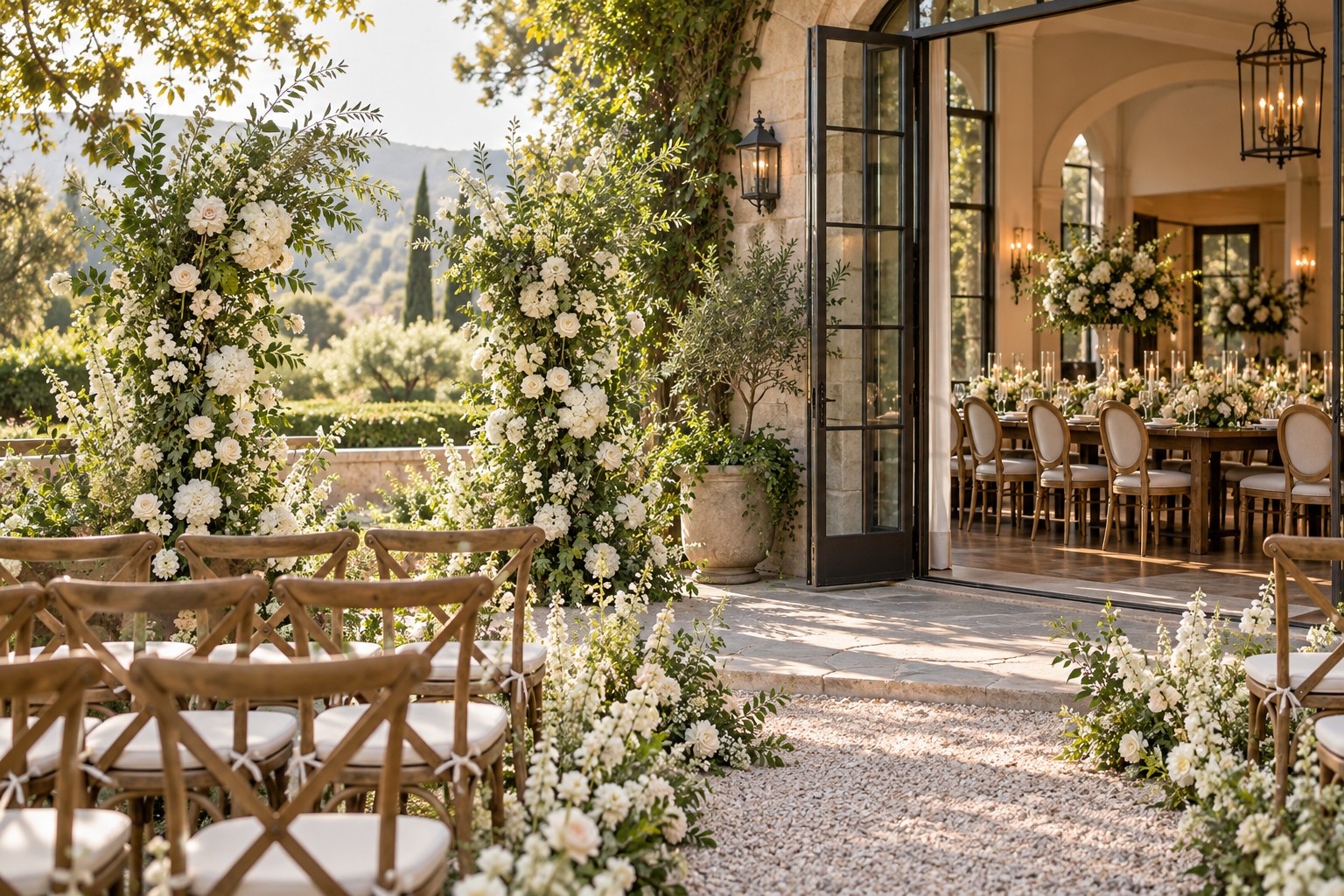
Wedding arrangements need to work in the room where you say your vows and, sometimes, in a second room where you celebrate afterward. Those are two different design jobs. A floral arch that frames an outdoor ceremony may be too large for a reception entrance. A pair of aisle arrangements may look complete at the altar, yet feel undersized on a wide stage. The useful question is not simply, “Can we reuse these flowers?” It is, “What arrangement plan fits the space change, and will each piece still look intentional if it moves?”
Start with the transition your venue actually requires. If you are holding both moments in one room, the flowers may need to remain in place while guests move around them. If the spaces are separate, selected designs might travel while the ceremony area stays undisturbed. If you are changing venues, the schedule, access, and travel time become part of the design decision. This comparison helps you choose a plan before you select individual pieces with your florist.
Keep the Wedding Command Center or your planning notes focused on a few useful decisions: the first setting, the second setting if there is one, the person responsible for each move, and the backup plan. That is enough to carry the design intent into a florist conversation without turning the floral brief into a general wedding checklist.
Choose a transition model before choosing wedding arrangements
Before you talk about flower varieties, describe how people and spaces will change between the ceremony and reception. Ask the venue which areas remain open, when the reception room can be accessed, whether guests will be nearby during setup, and who is permitted to move structures. The answers reveal whether your arrangements should stay put, move as complete units, or be designed as separate pieces from the start.
Think in three patterns. A same-room flip means the ceremony and reception use the same room, so tables or other features change while guests are elsewhere. Separate rooms at one venue means guests travel between ceremony and reception locations within one property. Different venues means the floral plan must account for travel between addresses. Your venue may combine patterns, such as a ceremony on a lawn, cocktails on a terrace, and dinner in a ballroom. In that case, map each change separately.
This first decision is about constraints, not about limiting the look. It protects the floral design from depending on a room that is still occupied, a structure that cannot fit through a doorway, or a move that has no agreed labor behind it. It also prevents you from paying for duplicate statement pieces when one well-sized design can serve both moments, if the plan truly supports that use.
Draw a simple venue sequence with the ceremony location, guest route, cocktail area, reception entrance, and dinner room. Add the time each area becomes available and the time guests arrive. You do not need a polished floor plan to start the conversation. A rough diagram helps the florist and venue coordinator spot pinch points and propose arrangements that fit the actual route.
One distinction matters: moving flowers is not automatically a saving. A design may require extra labor, a second vessel, a change in mechanics, or a separate reception piece to keep the room looking complete while flowers are being relocated. A Mississippi State University Extension guide discusses why floral reuse should be evaluated during consultation rather than treated as an automatic benefit. Ask for the labor and materials to be included in the proposal, then compare the complete plans.
Compare three ceremony-to-reception floral plans
Plan A: Keep the ceremony flowers in one shared room
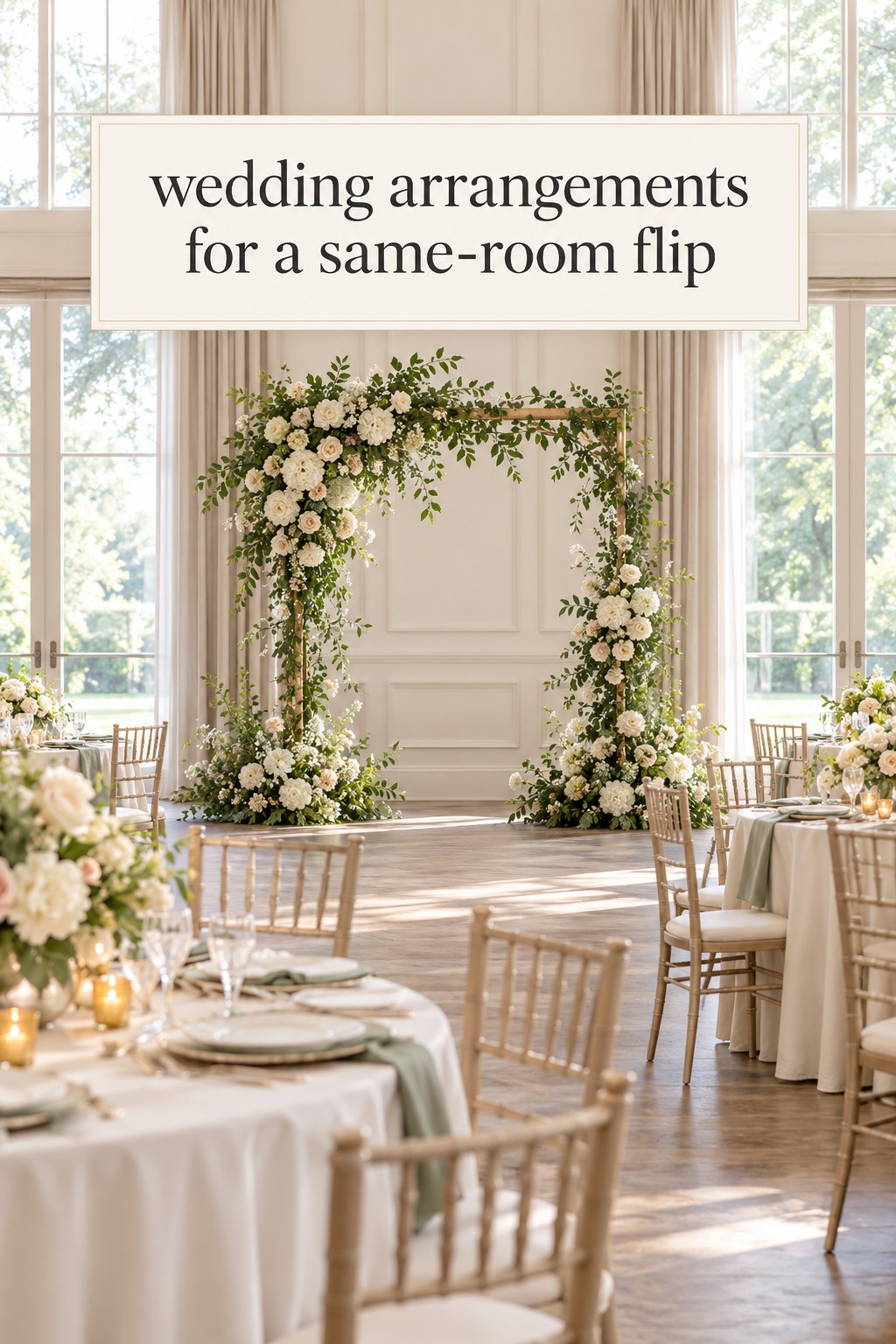
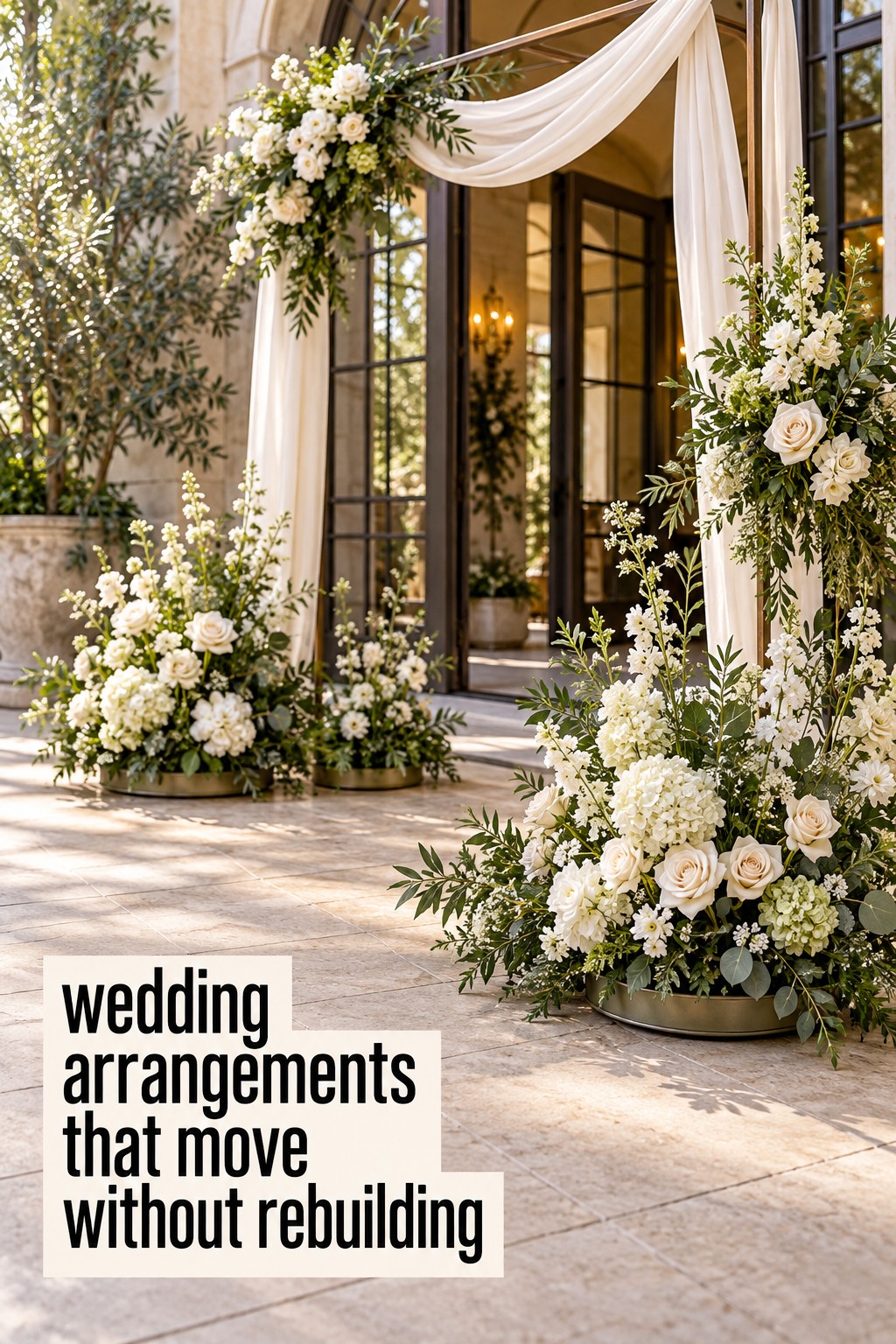
If the ceremony and reception happen in the same room, a room flip may sound efficient, but it can create a narrow window. The room may need new table placement, linens, or service setup while the floral team is also expected to dismantle and rebuild pieces. An alternative is to design the ceremony focal point so it remains part of the reception. A freestanding pair of arrangements at the front can later frame a sweetheart table or stage without a full reconstruction, provided the couple and guests will not need the ceremony area for extended portraits.
This approach works when the ceremony backdrop has a clear second role and does not block service, guest sightlines, or the dance floor. Place it where it will still look balanced after chairs are removed or tables shift. The ceremony arrangement may have a “front” facing the aisle, so ask whether it will also be viewed from the sides or rear during dinner. A small turn or change in spacing may be enough, but it should be planned rather than improvised.
The tradeoff is that the room continues to carry the ceremony focal point into the evening. That creates continuity, but it may not suit a reception design that needs a different visual center. If the room must be cleared quickly or the flowers occupy the only practical route for staff, a fixed ceremony piece plus a separate reception centerpiece can be the calmer choice. Ask the venue to confirm whether the space is available for a full flip, and ask the florist what can stay safely in place.
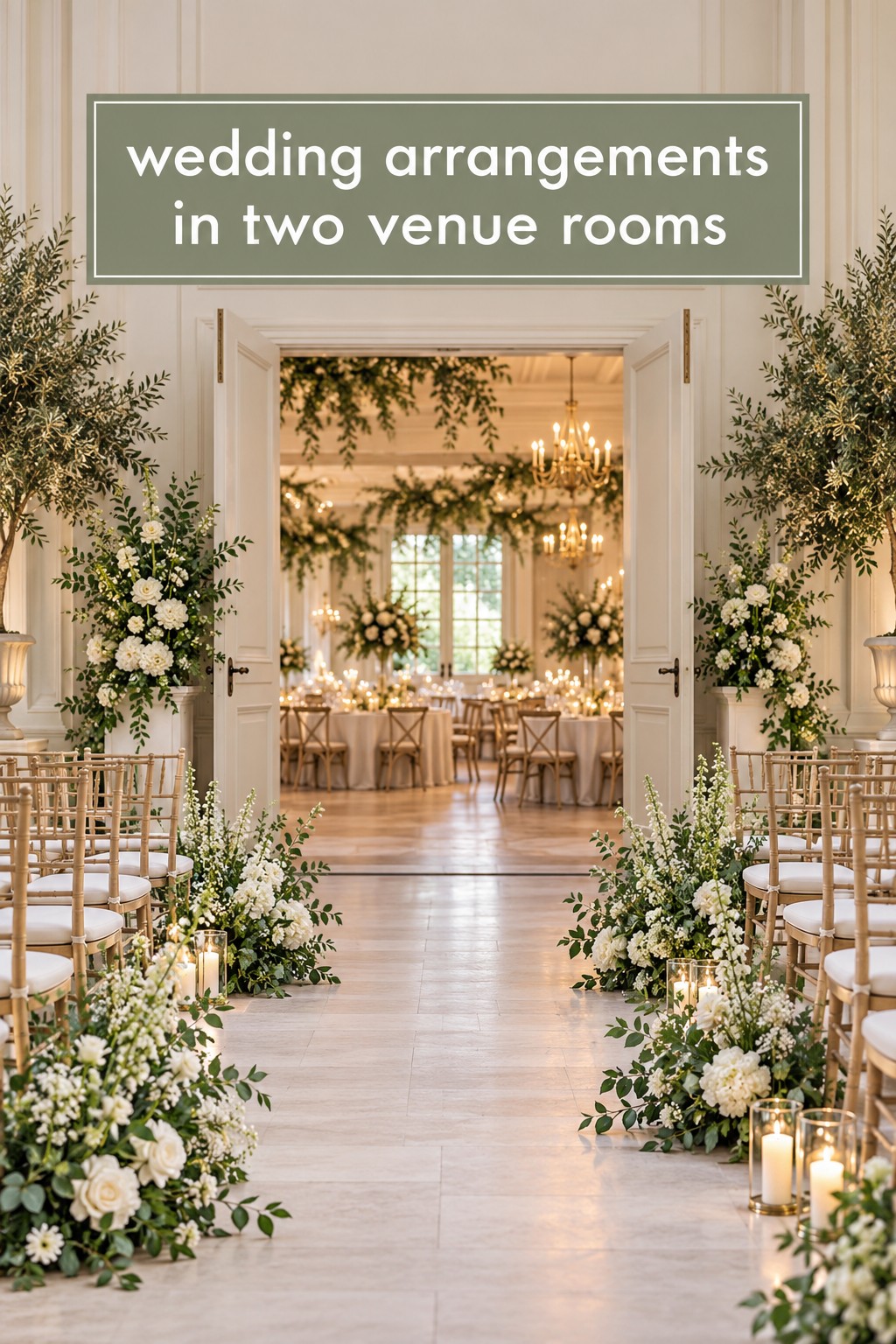
Plan B: Move selected pieces between separate rooms at one venue
When the ceremony and reception use different rooms on the same property, you can preserve the first installation and move only the pieces that have a useful destination. For example, two stable arrangements at the ceremony entrance might later frame the reception entrance, or low aisle pieces might become accents near the head table. A modular design, where separate clusters are built as distinct units, gives the florist more options than one large piece attached across a structure.
This is often the most flexible plan because the ceremony area can remain available for photographs while the reception is prepared elsewhere. Still, “same venue” does not mean “easy move.” Elevators, stairs, long corridors, outdoor paths, restricted freight doors, and guest traffic all affect which pieces can travel. Have the venue identify an approved route and loading access. Have the florist decide whether each piece can be carried in its vessel, needs a support tray, or needs to be taken apart and restyled.
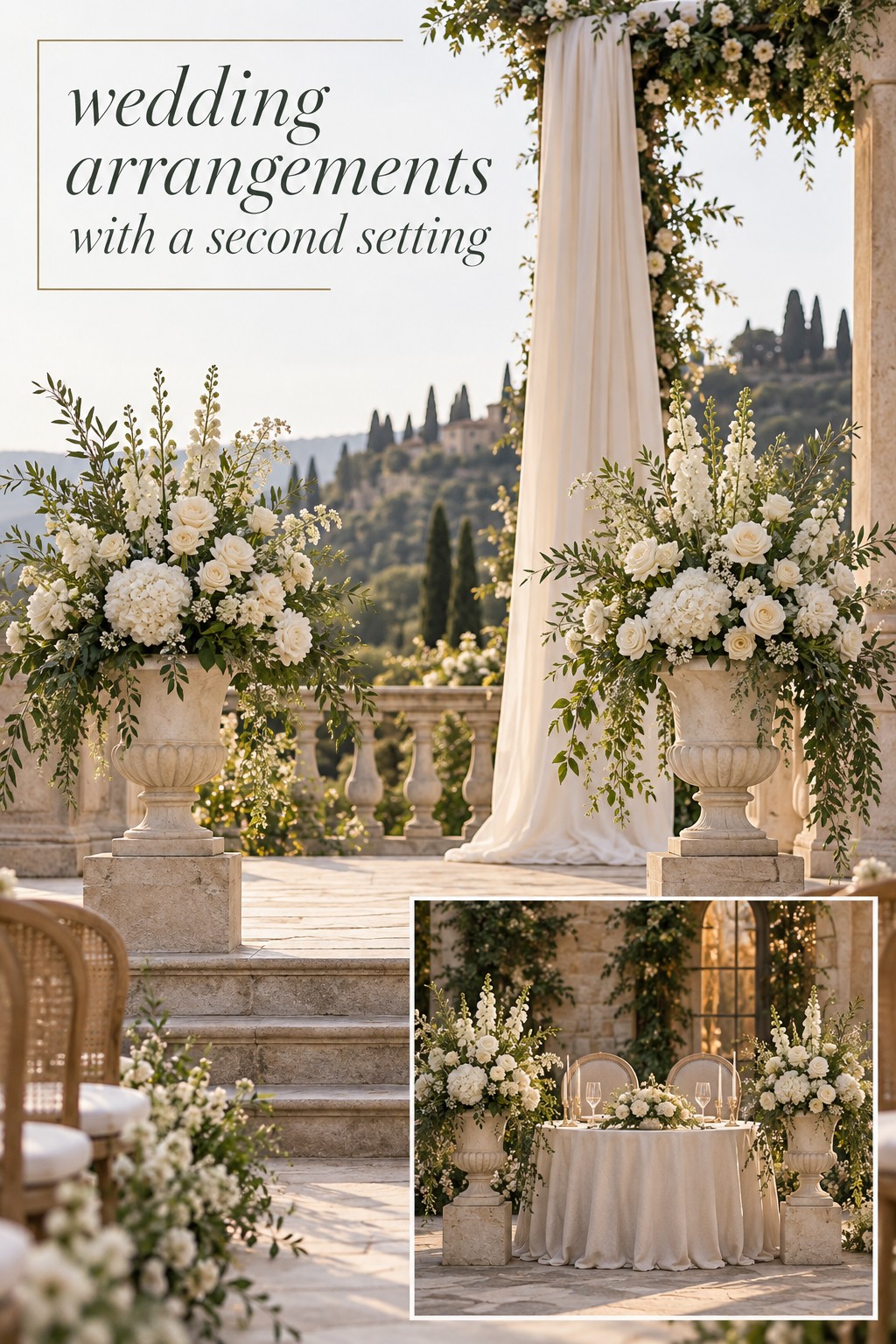
Design the second placement to suit the arrangement’s scale. A low aisle cluster may be lovely at the foot of a ceremony installation but almost disappear beside a large head table. Conversely, a tall pedestal piece might dominate a small welcome table. If it is moving to guest tables, check the number of pieces, table dimensions, guest sightlines, and available space for place settings. Reuse should solve a design need at the destination rather than merely fill an empty spot.
The tradeoff is added coordination. The florist may need a crew member to relocate and reset pieces while guests attend cocktail hour. The couple should not be assigned this job, and a family member should not be asked to move a heavy or wired installation without the florist’s approval. A recent guide from Pearson Floral Designs notes that attachment method, access, staffing, guest photo use, and transition time can determine whether a reuse plan is realistic. Bring those exact questions to your own venue and florist.
Plan C: Use different venues for ceremony and reception
When the ceremony and reception happen at different addresses, treat the flowers as two coordinated installations unless your florist confirms a specific move is practical. A transfer now includes packing or securing the design, loading, travel, venue access, unloading, and placement. Even if the locations are close, the route and schedule matter. The ceremony team may need to stay for photographs, and reception vendors may be preparing the room at the same time.
A strong option is to create a visual thread rather than moving every piece. Repeat a flower color, foliage shape, or container style in both locations, while allowing each arrangement to fit its own setting. For instance, the ceremony can have a defined focal installation while the reception uses table arrangements that are designed for dining and conversation. If a portable aisle marker has a clear second use and someone is contracted to move it, include that one transfer in the plan. Do not make the entire reception design depend on a last-minute rebuild.
The tradeoff is that separate installations may require more flowers or a different allocation of the budget, while a transfer may add labor and transport. Compare the written totals and the expected visual result, not a vague promise that one set can “do double duty.” Ask whether the proposal includes travel, repacking, setup, any second vessel, and the time needed to install at the new address. If these responsibilities are outside the florist’s scope, get a named and capable professional to own them before you commit.
This plan is especially helpful when the two venues have distinct architecture or lighting. A small garden ceremony and a large indoor reception may call for different scales. Shared colors and shapes can make them feel related without forcing one arrangement into two jobs it was not built to perform.
Judge each arrangement in both of its settings
For every arrangement that may move, ask the florist to describe its first job and its second job. “At the altar” is a location, but it is not a full design brief. Is the piece framing the couple, filling a wide background, softening a doorway, or creating a low border? Its second setting should have a similarly clear purpose, such as marking an entrance or anchoring one end of a long table. If neither role is clear, the piece may not need a second placement.
Check scale twice. Compare the arrangement with the height and width of each setting, not only with the nearby furniture. A pair of low arrangements can read as a strong focal point in a small ceremony area, then seem scattered against a broad reception backdrop. A large urn may be beautifully proportioned beside a ceremony arch but too imposing beside a narrow doorway. Share photographs or measurements of both spaces so the florist can propose a suitable size.
Check the viewing direction. Guests may approach from a different side than the ceremony audience. Ask if the arrangement is designed to be seen from all sides or primarily from one. Then confirm the second position offers the intended view. If a piece is against a wall or backdrop for the ceremony, it may need a different orientation or companion piece when used in the center of a reception area.
Check the mechanics. Ask how the piece is supported, how it will be lifted, whether it travels in one unit, and what must be adjusted after arrival. Freestanding modular clusters, stable vessels, and arrangements built on a moveable tray may be easier to reposition than florals wired directly to a structure. The florist should make the call on handling and safe installation. Do not ask a coordinator or friend to cut ties, remove wiring, or rebuild a piece unless the designer has given specific instructions and agreed that this is within their ability.
Check guest comfort. At a reception table, flowers should leave room for place settings and allow guests to see and speak to one another. At an entrance or welcome display, the design should not narrow the path. Near a bar or food station, confirm it will not take up needed service space. These are not reasons to avoid statement pieces. They are reasons to choose their placement intentionally.
Check the visual story. Repeating a floral palette can create continuity, but every table does not need a copy of the ceremony focal piece. Mix one signature arrangement with smaller accents if that better suits the room. If you want the reception to feel distinct, use the same color language with a different silhouette, flower mix, or height. The goal is a considered sequence, not an identical backdrop in every photograph.
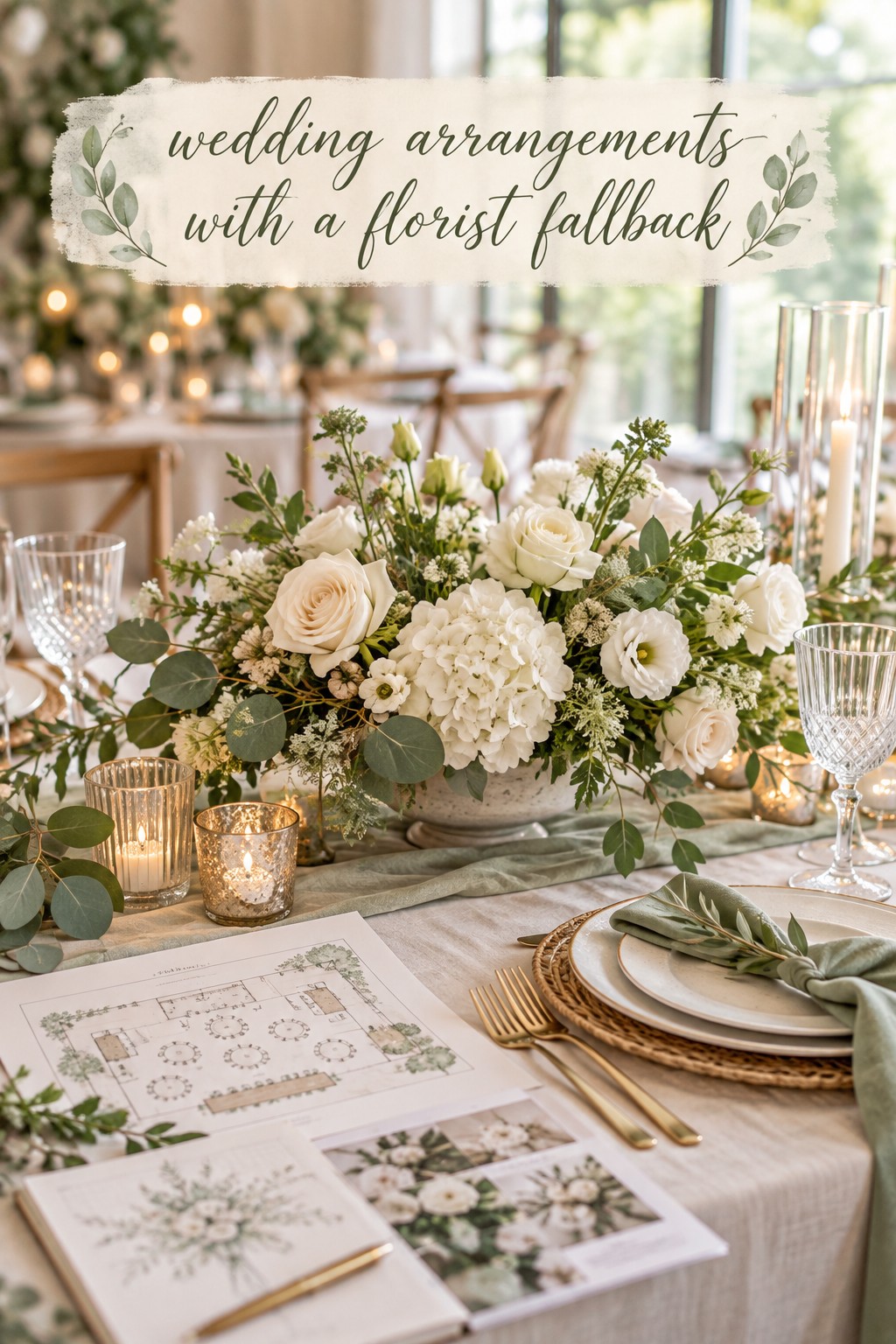
A simple two-column sketch can help. Label one side “ceremony” and one “reception.” For each key design, note its size, viewing direction, intended role, and whether it stays, moves intact, or is rebuilt. Review the sketch with the florist and venue coordinator together if possible. A Wedding Command Center can hold the approved version with the floral proposal and floor plan, so the team refers to the same decision instead of relying on an old inspiration image.
Give the florist a plan with a clear fallback
Send a short written brief before finalizing the proposal. Include the venue transition pattern, approximate room sequence, photographs or measurements for both settings, and the floral moments you consider most important. Identify which arrangements should stay, which might move, and which should be designed separately. Ask the florist to flag any idea that depends on a route, access window, installation method, or crew member that is not yet confirmed.
For each planned move, agree on four details: the arrangement’s second location, who will move and restyle it, the time and route they will use, and the labor or materials included in the proposal. Confirm whether the florist will stay on site, return later, or hand any task to another professional. Contract scope varies, so write down the agreement rather than assuming setup, transfer, or removal is included.
Choose a fallback that protects the reception design if the transition changes. The ceremony may run late, the room may become available later than expected, weather may move an outdoor event indoors, or a path may be closed. A fallback could be leaving the ceremony arrangement in place and using the reception accents already included in the plan. It could also be a smaller portable piece reserved for the destination. Ask the florist which fallback keeps the look coherent and what it costs before the event.
Keep the final review practical. Confirm the florist and venue agree on access, the second placements are visible on the floor plan, the arrangements can be handled as designed, and the staffing is included. Revisit the decision if the room layout changes. If you remove a proposed second use, ask whether the floral count or quote should change as well. A clear “stay, move, or build separately” decision is more useful than a broad note to reuse as much as possible.
Above all, let the flowers serve the experience you want in each space. A reuse plan can extend a focal point and connect two rooms, but it does not have to dictate the entire design. The right plan is the one that looks intentional in the ceremony, fits the reception, and has a realistic way to get from one purpose to the next.
Sources and methodology
This guide compares real venue transition patterns using floral-design pages reviewed for mechanics, placement, staffing, and timing. Pearson Floral Designs’ discussion of repurposing ceremony flowers informed the questions about attachment, access, and guest use. The Mississippi State University Extension farmer-florist consultation guide supports discussing labor and reuse as part of the floral proposal. Exact access, contract scope, staffing, and room timing vary by venue and vendor, so confirm them directly. This article does not claim that moving arrangements always saves money or that a particular flip duration is universal.
FAQ
What wedding arrangements are easiest to reuse?
Arrangements designed as stable, separate units are usually easier for a florist to assess for reuse than flowers attached directly to a large structure. Ask the designer how each piece is supported and what its second setting will be. The florist can confirm whether it is appropriate to move.
Should ceremony flowers always move to the reception?
No. Some arrangements look best where they were installed, and some transitions do not leave enough time, access, or labor for a move. Compare the design and the complete plan with your florist. A separate reception arrangement may be the better fit.
Can we reuse flowers if the ceremony and reception are in one room?
Possibly. A ceremony focal piece might stay in the room and serve as a reception backdrop, or selected arrangements may move during a room flip. Confirm access, guest routes, reset time, and who is responsible before relying on either option.
What should I ask my florist about moving arrangements?
Ask where the arrangement will go, how it is supported, whether it can move intact, who will handle it, what labor or materials are included, and what happens if the schedule or room changes. Share the venue route and photographs of both placements.
Do repurposed wedding arrangements save money?
They may reduce the need for duplicate pieces, but labor, transport, new vessels, or restyling can change the total. Ask for an itemized comparison of a reuse plan and a separate-installation plan. Decide based on the written scope and visual result, not an assumed saving.
How do I make wedding flowers feel cohesive at two venues?
Repeat a color, flower, foliage shape, or container detail while letting each arrangement suit its own room. Cohesion does not require identical centerpieces. Ask the florist to show how the ceremony and reception designs connect in scale and overall mood.
When should we decide where arrangements will go after the ceremony?
Discuss the second placement while the florist is planning the designs, before the proposal and installation method are final. The florist and venue can then check size, route, access, staffing, and timing together. Update the plan if the layout changes.
Leave a Reply