
Planning a wedding in six months can feel like trying to fit a year of decisions into one crowded calendar. The good news is that you do not need to make every possible wedding choice immediately. You need to make the decisions that affect availability, budget, guests, and other decisions first.
This 6 month wedding planning timeline gives you a practical order of operations from the first week through the final days. It is designed for couples who want a beautiful, personal celebration without treating every tradition as mandatory. You can adapt it for a small city hall ceremony, a formal evening wedding, a destination weekend, or a larger local celebration.

The central rule is simple: protect the essentials, simplify the extras, and keep one current record of decisions. If you have only six months, flexibility is a planning resource. A weekday date, a smaller guest list, an all-inclusive venue, ready-to-wear attire, or a shorter menu may give you more breathing room without changing what the wedding means to you.
Before month one: create the foundation
Before contacting vendors, have one focused conversation with your partner. Agree on the kind of experience you want guests to have, the parts of the day that matter most, and the limits you need to respect. The goal is not to create a perfect vision board. It is to give yourselves a filter for quick decisions.
Set a working budget
Write down the total amount you can realistically spend, including contributions from family or other supporters. Clarify whether any contribution has conditions attached. Then divide the budget into broad categories such as venue and food, attire, photography, music, flowers, stationery, transportation, beauty, ceremony, lodging, and contingency.
Do not use the entire amount in your first quotes. Taxes, service charges, alterations, postage, tips, delivery, overtime, and last-minute replacements can change the total quickly. A small contingency is more useful than a budget that looks precise but leaves no room for real life.
Choose a guest range
A preliminary guest range helps you evaluate venues and catering. You do not need a final list on day one, but you should know whether you are planning for 30, 80, or 180 people. Separate the people whose presence feels essential from the wider group you may invite if the budget and venue allow it.
Choose a planning home
Keep the budget, guest list, vendor quotes, contracts, payment dates, questions, and decisions in one shared place. Give every open item an owner and a next action. The Wedding Command Center can be useful as a central planning resource when you want both partners to see the same priorities and deadlines. The point is shared visibility, so use the system that you will actually maintain.
- Budget: total, deposits, remaining balance, and contingency.
- Guests: names, addresses, RSVP status, meal needs, and travel notes.
- Vendors: contact details, contracts, payment dates, and arrival needs.
- Decisions: what was chosen, why, cost impact, and who handles the next step.

Month 6: secure the date, venue, and scarce vendors
The first month carries the most pressure because your biggest decisions are connected. Venue capacity affects guest count. The date affects vendor availability. The venue contract affects catering, rentals, alcohol, access hours, and the rain plan. Work on these decisions as a group instead of treating them as unrelated tasks.
Book the venue and set the date
Contact several venues at once and lead with your date range, guest estimate, ceremony plan, and budget. If your preferred Saturday is unavailable, ask about Friday, Sunday, weekday, off-season, or lunch options. A flexible date can protect your preferred location, guest experience, or vendor team.
Read the contract carefully. Ask about access and cleanup hours, catering rules, bar service, staffing, noise limits, insurance, candles, outside vendors, parking, accessibility, weather backup, and payment deadlines. Compare the full expected cost rather than the rental fee alone.
Book the vendors that disappear first
Once the date is firm, contact the vendors whose availability matters most to you. This often includes a photographer, planner or coordinator, officiant, caterer, entertainment, and beauty team. Your exact order may change if the venue includes catering or if the ceremony requires a specialist.
Send the same short brief to each vendor. Include the date, location, guest range, service needed, priorities, and decision deadline. Ask for the total price, what is included, payment schedule, cancellation policy, substitution policy, overtime rates, and next steps. A quick response is helpful, but a contract you understand is more important.
Make the attire decision early
Six months can be enough for attire, but the best path depends on the garment and the supplier. Ask about delivery and alteration timing before ordering. Consider sample gowns, off-the-rack pieces, made-to-measure options, a suit or tuxedo with a reliable local tailor, or a simpler custom design. Schedule alterations when you purchase rather than hoping an appointment will appear later.

Month 5: build the guest and event structure
With the date and venue secured, turn your attention to the people moving through the day. A wedding plan becomes much easier when you know how guests will arrive, what they need to understand, where they will eat, and how they will move between ceremony and reception.
Refine the guest list and communication plan
Finalize a working guest list and collect accurate names, mailing addresses, email addresses, dietary information, and accessibility needs. If many guests will travel, publish a simple wedding website or information page with the date, location, lodging suggestions, transportation notes, dress code, and RSVP instructions.
On a short timeline, you may not need save-the-dates. If you do send them, keep the message simple and send it as soon as the venue and date are certain. Otherwise, move directly to invitations and give guests a clear response deadline that leaves enough time for final counts.
Confirm food, rentals, and the room plan
Book or confirm catering, cake or dessert, rentals, and bar service. Ask which items the venue provides and which you must source. Discuss dietary accommodations, children’s meals, service style, staffing, water, coffee, late-night food, and the timing of dinner.
Sketch the room flow. Mark the ceremony entrance, guest seating, cocktail area, bar, dinner tables, dance floor, restrooms, gift table, accessible routes, and vendor access. You do not need a final floor plan yet, but noticing a problem now is much easier than solving it during the final week.
Start the ceremony and design direction
Meet with your officiant and decide what kind of ceremony feels right. Discuss readings, vows, music, family or cultural traditions, length, and who needs to participate. For design, choose a small set of anchors such as color, texture, lighting, and flower shape. A clear direction makes it easier to approve invitations, attire, rentals, and floral proposals without restarting the whole conversation.
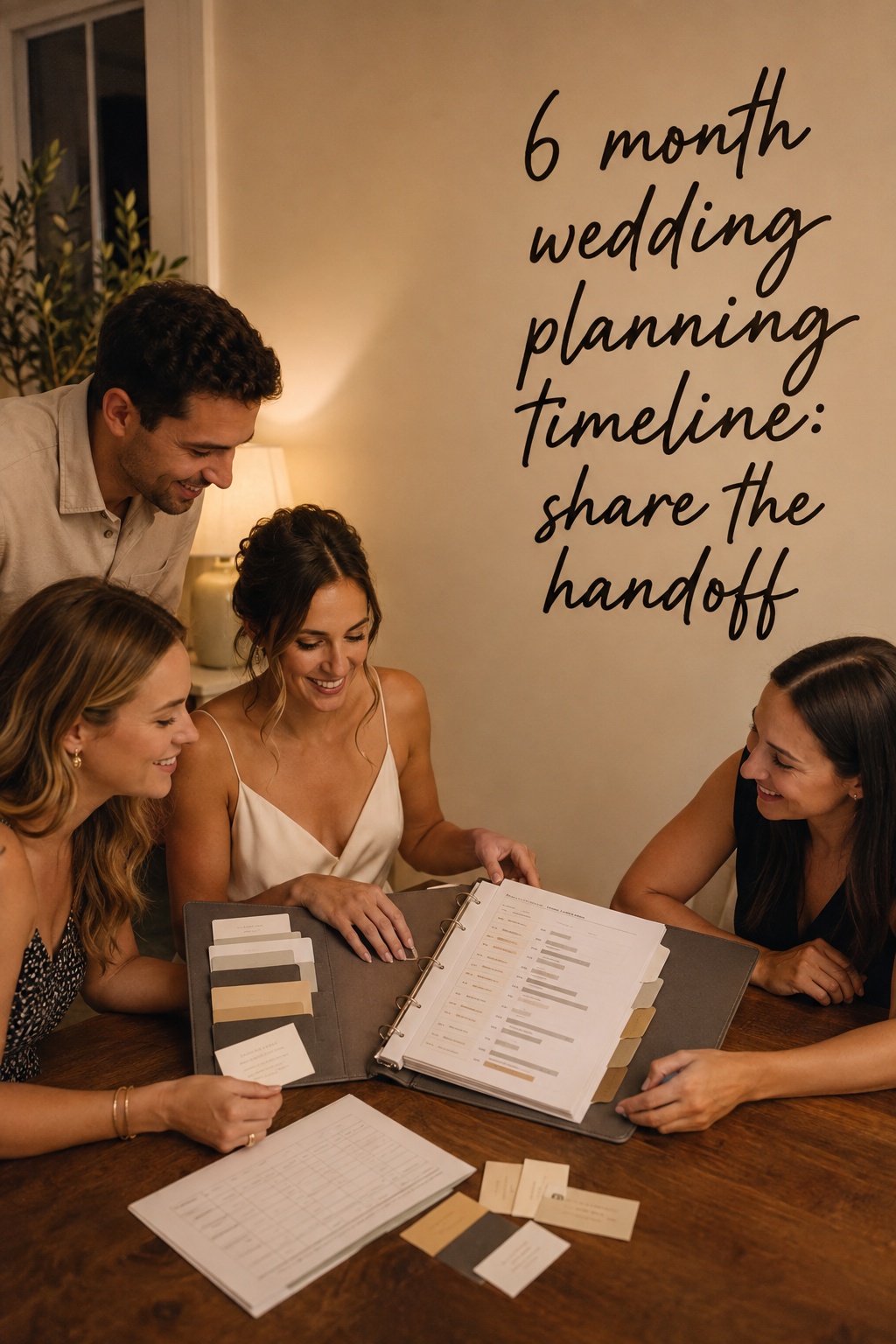
Months 4 and 3: convert decisions into guest-ready logistics
By the middle of your 6 month wedding planning timeline, exploration should give way to confirmation. You can still adjust details, but every change should be tested against the budget, guest experience, and vendor lead time.
Order and proof the invitations
Order invitations early enough to proof them, address them, check postage, and mail them with time for responses. Verify names, dates, times, venue wording, website links, meal questions, and any enclosure cards. Order a few extras for mistakes, late additions, keepsakes, and detail photographs.
Make the RSVP system easy to maintain. Track every invitation, response, meal selection, plus-one, address change, and follow-up in one place. Decide who will contact guests who miss the deadline. A clean RSVP process protects the seating plan and the catering count.
Finish the visual and personal details
Finalize flowers, linens, rentals, signage, stationery, music direction, and any personal elements that require production time. Choose wedding-party attire and share ordering instructions. Purchase rings and schedule sizing or engraving. Book hair and makeup trials, then record the agreed look and timing.
Plan travel and lodging for yourselves and any guests who need help. Reserve wedding-night accommodation and make honeymoon arrangements if you are traveling immediately after the ceremony. Check passport, identification, and marriage-license requirements for your location. Rules differ by state and county, so use the official local source rather than an old checklist.
Draft the day-of schedule
Start a working schedule with getting ready, transportation, portraits, ceremony, cocktail hour, dinner, speeches, first dance, dancing, and departure. Ask your photographer, venue, caterer, entertainment, and planner to review the timing. Build in realistic transitions, meal breaks for vendors, and extra minutes for people who need assistance.
Month 2 through the final week: close the loop and hand off
The last two months are for closing open loops, not adding a second wedding. Your goal is to make the plan understandable to someone else. That is what protects you from answering operational questions all day on your wedding day.
Two months out
- Follow up on missing RSVPs and record dietary or accessibility needs.
- Confirm the menu, cake, bar, rentals, flowers, and transportation.
- Schedule fittings and beauty trials, and confirm wedding-party attire.
- Review the ceremony order, readings, music, vows, and legal requirements.
- Choose gifts, rehearsal or welcome-event details, and guest communication.
One month out
Freeze the guest list when your vendors require the final count. Create the seating chart, finalize the room layout, approve printed materials, and collect all remaining vendor questions. Confirm delivery windows, setup responsibilities, contact people, payment amounts, tips, and emergency procedures.
Prepare one concise handoff document. Include the final schedule, venue address, vendor contacts, guest count, seating plan, floor plan, ceremony order, family photo list, transportation plan, delivery notes, payment information, and the person authorized to make decisions. Share only the information each person needs.
Final week
Confirm the schedule with your venue, planner, coordinator, and key vendors. Pack attire, rings, documents, emergency supplies, ceremony items, and personal details. Prepare final payments according to the contracts. Assign a trusted person to answer questions and protect your attention.
Most importantly, stop expanding the plan. A short timeline rewards completion more than perfection. Eat regular meals, protect sleep, and make time to be with your partner without discussing logistics. The success of this 6 month wedding planning timeline is not measured by how many optional details you add. It is measured by whether you can arrive at the celebration feeling present.
Mistakes to avoid on a six-month timeline
- Waiting for the perfect Saturday instead of considering a workable date range.
- Comparing dozens of vendors after you already have a strong, available option.
- Ordering custom attire without confirming delivery and alteration timing.
- Keeping budget, guest, and vendor information in separate private systems.
- Adding DIY projects that create work without improving the guest experience.
- Leaving the final schedule in the couple’s heads instead of handing it to a coordinator.
FAQ
Is six months enough time to plan a wedding?
Yes, especially when you keep the guest count and design scope realistic, make fast decisions, and stay flexible about dates and vendors. A smaller wedding or an all-inclusive venue can reduce the number of separate decisions. A large, destination, or highly custom celebration may need more compromises.
What should you book first with six months to go?
Start with the venue and date, then book the vendors with limited availability, such as a planner, photographer, officiant, caterer, entertainment, and beauty team. The exact order depends on what your venue includes and which parts of the day matter most to you.
When should invitations be sent for a six-month wedding?
Many couples send invitations around 10 to 12 weeks before the wedding when planning on a short timeline. Choose an RSVP deadline that gives your caterer and venue enough time for final numbers. For a destination wedding, send information earlier and include travel details as soon as they are confirmed.
What if the venue I want is not available?
Ask about weekday, Friday, Sunday, off-season, lunch, or winter dates. You can also keep the date and choose a different venue with a similar guest capacity and atmosphere. Decide which factor is least important before you begin searching, so flexibility feels like a strategy rather than a failure.
Can I order a wedding dress with only six months left?
Sometimes, but ask the retailer for a written delivery estimate and confirm that alterations can be completed before the wedding. Sample, off-the-rack, made-to-measure, and suit options may offer more reliable timing. Avoid choosing a garment based only on its appearance without checking the full production schedule.
How can couples divide planning work fairly?
Divide ownership of outcomes rather than small errands. One partner might own vendor communication and the other guest communication, while both review contracts and budget changes. Keep the owner, next action, and due date visible. A shared system prevents one person from becoming the only person who knows what is happening.
How do we keep a short wedding timeline from taking over our lives?
Set one weekly planning meeting with a clear end time, keep a short list of current decisions, and protect regular time that is not about the wedding. Use your planning system to capture thoughts between meetings instead of turning every conversation into a task review. The purpose of structure is to make room for your relationship.
Use a weekly rhythm to keep the plan moving
A monthly timeline is useful for seeing the whole path, but most wedding decisions are completed during ordinary weeks. Choose one planning meeting each week, ideally at the same time. Keep it short enough that you can finish with energy. Begin by checking deadlines, then choose the two or three decisions that genuinely need attention before the next meeting.
Use a simple three-part agenda. First, review what changed: a vendor reply, a payment, an RSVP, or a delivery estimate. Second, make decisions that are blocking other work. Third, assign the next actions. If a task has no owner or due date, it is not yet part of the plan. This habit prevents open questions from floating through every conversation.
Prioritize by scarcity and dependency
When several tasks feel urgent, ask two questions. How difficult will this item be to replace if it falls through? How many other decisions depend on it? A venue has high scarcity and high dependency, so it belongs near the beginning. A welcome-bag ribbon may be easy to replace and affect almost nothing else, so it can wait or disappear.
This framework also helps when a preferred option is unavailable. You might protect the photographer and change the date, protect the guest count and change the venue, or protect the budget and simplify the flowers. A deliberate trade-off is easier to live with than an accidental one made under pressure.
Use decision deadlines, not endless research
For each open choice, set a research limit and a decision date. Compare a small number of strong options using the same criteria. Record the price, availability, what is included, concerns, and the reason for your final choice. Once the decision fits the priorities, close it. Reopening a settled decision should require new information, not a difficult mood on a busy evening.
Leave space for questions that can only be answered later. You may not know the final seating arrangement before RSVPs arrive, the precise floral recipe before the season is confirmed, or the final schedule before vendors review the room. Mark these as planned later decisions instead of treating them as failures to decide now.
Protect the relationship inside the timeline
Six months is a short planning period, but it is not a reason to make the wedding the only subject in your home. Decide which conversations belong in the weekly meeting and which can wait. Keep at least one regular activity that has nothing to do with the wedding. If one partner is carrying most of the invisible work, list the responsibilities rather than assuming the imbalance will solve itself.
Ask for help in specific ways. A family member may address invitations, a friend may manage a rehearsal dinner detail, and a coordinator may take vendor questions during the final weeks. Give each helper a clear brief and a boundary. Support should reduce decisions, not create a new stream of opinions that the couple must manage.
Leave a Reply