
A wedding organization board can do more than display an attractive plan. Give it one focused job: keep important choices visible, show what each choice depends on, and preserve why you decided. That way, when a venue asks about a date, a parent revisits the guest count, or a vendor sends a revised proposal, you can return to the decision instead of starting the conversation from scratch.
This is a decision board, not a mood board and not another master checklist. It does not need every address, payment, contract clause, or saved photograph. It needs enough context for the people involved to understand the question, compare realistic options, agree on an outcome, and know where the supporting detail lives. A paper board, shared digital canvas, or simple spreadsheet view can all work if the same information stays easy to find.

Why wedding decisions keep reopening when the reason is missing
Most planning friction is not caused by forgetting that a decision happened. It is caused by forgetting what the decision was meant to solve. A couple may remember choosing a venue, for example, but not that they accepted a smaller getting-ready room because the ceremony and reception could happen in one location. When a new space looks appealing, the conversation starts over because the trade-off was never made visible.
Unrecorded choices also invite people to compare different things. One person is thinking about guest comfort, another is focused on the total cost, and someone else is responding to a beautiful photograph. All three can have valid priorities, yet the discussion feels circular when nobody has named the criteria. A decision board puts the question and its constraints in view before opinions multiply.
There is a useful difference between a task and a decision. “Ask the venue about the rain plan” is a task. “Choose between the indoor ceremony room and the tent option” is a decision. The task can move through a simple status list. The decision needs alternatives, evidence, a person or pair responsible for the call, and a record of the result. Mixing these into one pile can make open questions look like forgotten chores.
A decision record helps most when a choice has consequences, depends on input from more than one person, or may be questioned again later. That might include the guest-count ceiling, ceremony format, venue, catering approach, or the division of responsibilities with family. It is unnecessary to formalize tiny choices that are easy to reverse. The board should reduce repeat discussion, not make wedding planning feel like office paperwork.
What belongs on a wedding decision board, and what belongs elsewhere
Start with a small set of decision cards. Each card should state one question in plain language, such as “Which of these two venues fits our guest needs and budget?” Add a decision owner, a target date, the people whose approval is needed, and a short description of what is already fixed. If a date, accessibility need, travel limit, or guest-count boundary rules out an option, state that up front.
Give each card a few comparable alternatives. Three options are usually easier to discuss than an open-ended collection, but there is no required number. An option can be “keep the current plan” or “wait for one missing quote,” not only a product or vendor. Include the evidence that matters, such as a proposal link, floor plan, menu, or a note from a site visit. Keep the original document in its proper folder and link to it from the card.
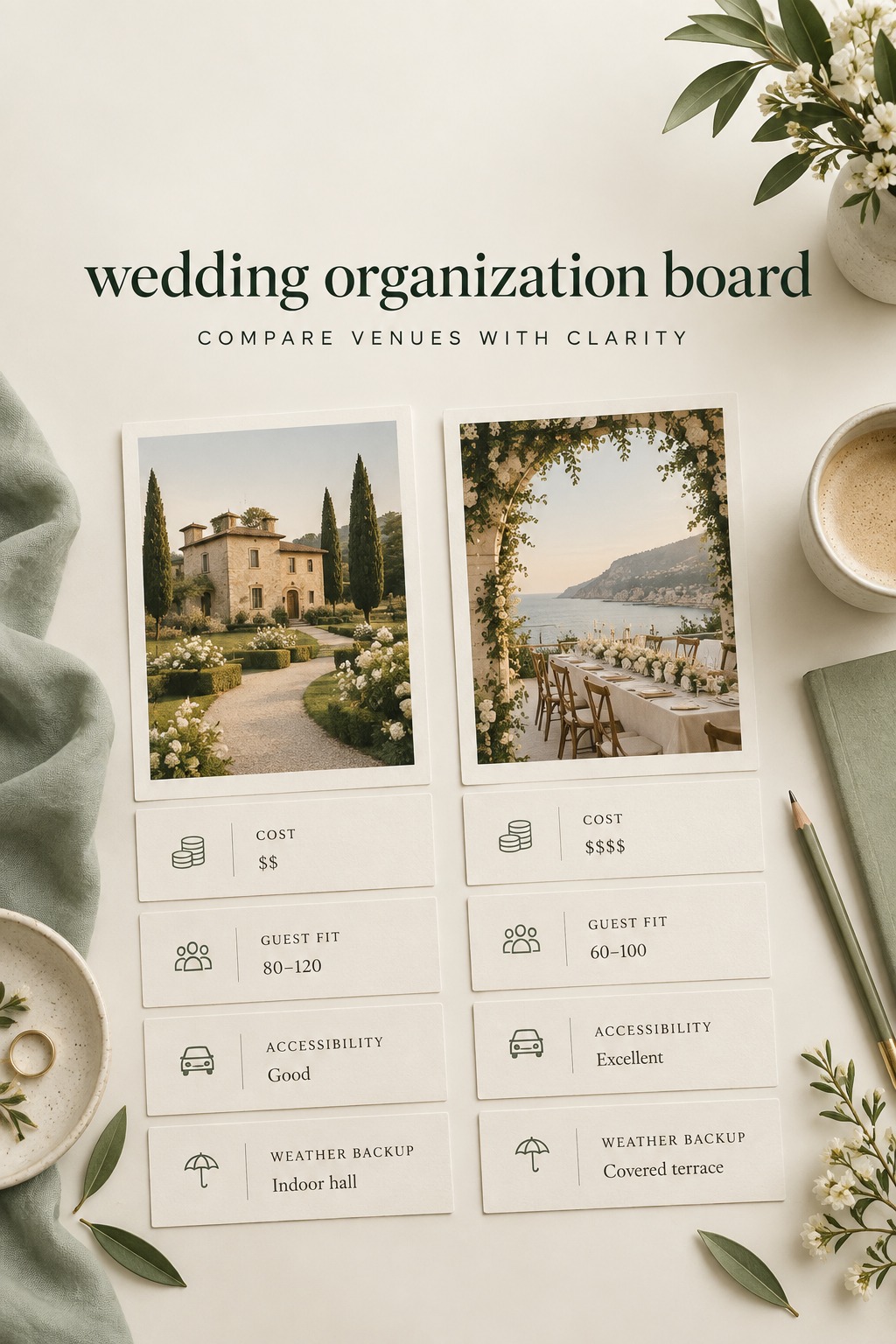
Choose a short list of criteria before scoring anything. For a venue, a couple might consider the full quoted cost, capacity, travel for guests, accessibility, weather backup, and the amount of setup the venue handles. The right criteria depend on the couple. A numbered score is optional; it can help compare options, but it should not disguise a hard requirement or pretend that two people value everything equally.
Record the constraints separately from preferences. “Must accommodate our confirmed guest range” is a constraint if the headcount is settled. “We like a garden setting” may be a preference. The distinction makes trade-offs easier to discuss. If a preferred feature conflicts with a fixed budget or a guest need, everyone can see the conflict rather than arguing about which option feels more exciting in isolation.
The board is an index, not a storage cabinet. Detailed payment schedules belong with the budget record; guest addresses and dietary information belong in the guest record; contract language belongs in the signed agreement. A shared planning spreadsheet can hold those details, while the board points to the relevant row, document, or folder. This approach reflects the structure of common planning workspaces that keep budget, guest, vendor, and timeline information connected, while letting each record serve its own purpose.
Use privacy judgment when sharing the board. A decision card can link to a restricted contract or private guest record without displaying personal details to every collaborator. Keep access to sensitive records limited to the people who need them, and avoid placing addresses, phone numbers, payment information, or private family context on a broad display board. A wall version can show the question and next step while the supporting files stay in a controlled digital location.
Build a decision card that another person can understand
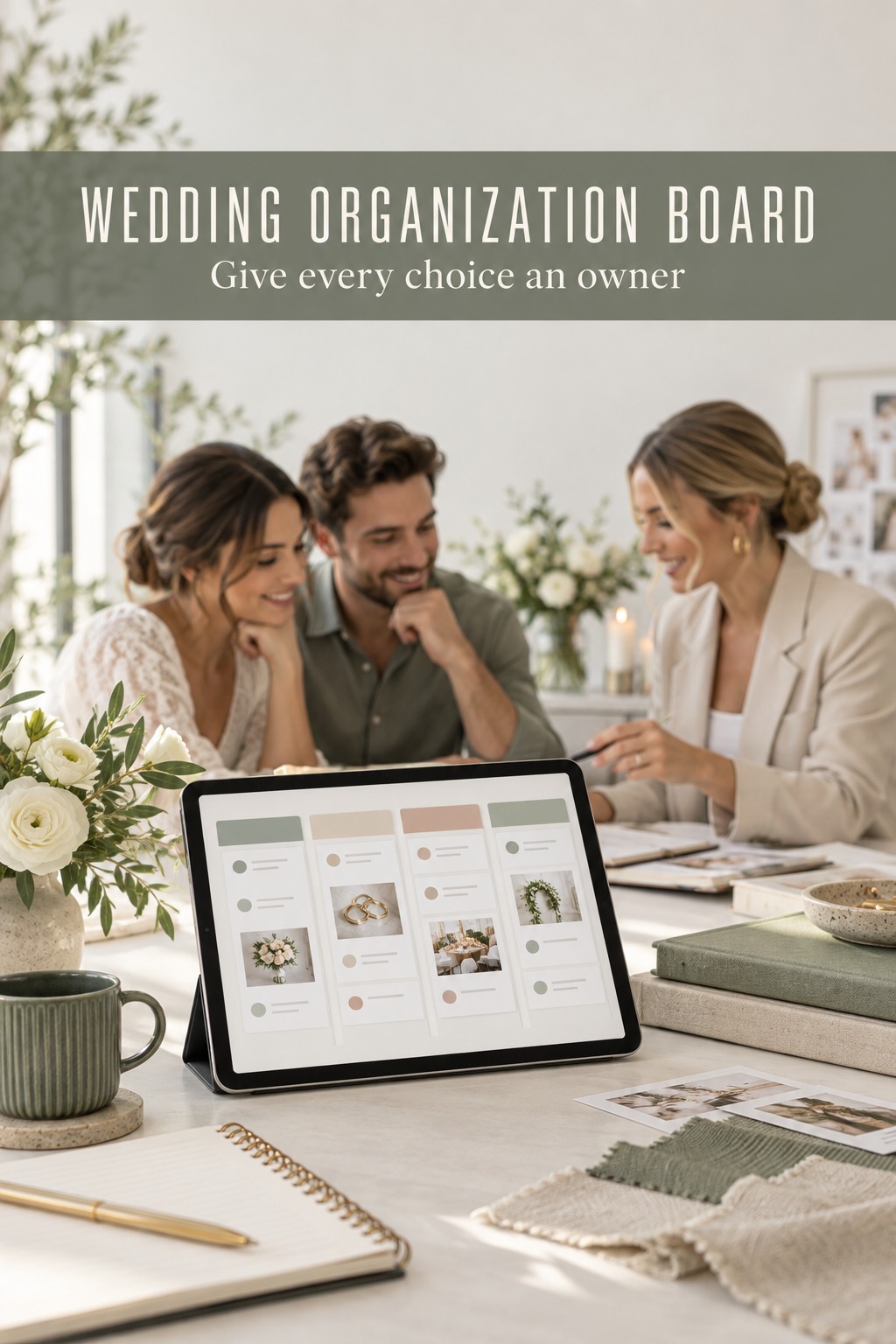
A useful card can be compact. Write the decision question, owner, deadline, alternatives, criteria, constraints, and source links. Leave a space for the outcome and the reason it was selected. Add a next action only when the choice creates one, such as asking for a revised proposal or confirming a hold. Anyone invited into the conversation should be able to tell whether the choice is open, waiting for evidence, ready for approval, or closed.
Keep statuses simple and meaningful. “Needs definition” means the question is still too broad. “Gathering input” means a missing quote or answer could change the comparison. “Ready to decide” means the alternatives and constraints are clear. “Decided” means the outcome and its rationale have been recorded. “Revisit” should be reserved for a real change in circumstances, not a passing urge to reconsider.
Agree on the board’s vocabulary before adding many cards. One person may say “pending” to mean the couple has not chosen, while another may mean the vendor has not replied. Those are different states. Use labels that name what is actually happening, and if a decision is waiting on someone outside the couple, write that person or organization and the date of the follow-up. A shared definition keeps the display from becoming ambiguous.
For a physical board, use one card per decision and reserve a small area for closed decisions. A card should be removable or easy to update, but do not throw it away as soon as a choice is made. The reason and approval may be useful months later during a vendor call or a family conversation. For a digital board, keep the closed card searchable and link to the final contract or confirmed record.

Use the board to compare options without turning every choice into a debate
Imagine that two venues are under consideration. Before comparing their photographs, write down the actual decision: “Which venue best fits our guest range, total budget, travel needs, and ceremony plan?” Add the confirmed date, an honest guest estimate, and any requirements that must be met. If the guest count is still changing, say so. A comparison built on an uncertain assumption should not be presented as final.
Next, collect the same kind of information for both venues. Put the quoted total in the budget record and link it. Note what each proposal includes, what remains unclear, and whether the ceremony and reception can use the same site. Link a floor plan or written venue response. If one venue has not answered a question, mark that evidence as missing instead of filling the gap with an assumption.
Now compare the options against the criteria the couple selected. A venue that looks beautiful may still be a poor fit if the guest route is difficult or the overall quote exceeds the couple’s limit. A less dramatic room may be a stronger choice if it meets the fixed needs and leaves room for priorities elsewhere. The point is not to calculate a mathematically perfect wedding. It is to make the reasoning legible so the couple can decide with the same facts in view.
When criteria conflict, write the trade-off in a sentence. For example: “We prefer the garden ceremony, but the indoor backup at Venue B makes the weather plan simpler, so we are choosing B.” The sentence need not convince every relative or predict the future. It needs to capture the couple’s priorities at the time of the decision. If the assumptions change, the record will show which part may need another look.
Before closing the card, state who has authority to decide. Couples may invite opinions from parents, a planner, or the wedding party, but input and approval are not always the same thing. A respectful process can welcome practical advice while making clear who owns the final choice. If a family contribution or shared budget changes that arrangement, discuss the expectation directly and record the agreed boundary in language everyone understands.
After choosing, update the relevant source record. Confirm the decision in the budget or vendor tracker, save the signed agreement in its folder, and note any resulting task. Then mark the board card decided and add the reason, date, and next action if there is one. That last step connects a conversation to real planning work, rather than leaving the board as a set of opinions detached from the wedding plan.
Keep the decision record useful through planning and handoff
A board only helps when it is current enough to trust. Set a short review at a time that already works for the couple, perhaps during a weekly planning check-in. Review cards that are ready to decide, identify choices waiting on evidence, and agree on a next step for each open item. Close completed decisions once their linked records are updated. If there is nothing to discuss, the review can be brief.
Do not treat every open card as urgent. A decision date should come from a real dependency, deadline, or agreed planning rhythm. If the venue choice affects the ceremony plan, guest information, or vendor availability, that connection belongs on the card. If the timing is flexible, avoid inventing pressure. A clear reason for the date helps collaborators understand why a choice is being discussed now.
Reopen a decided card only when a relevant fact changes. Examples include a vendor withdrawing, a quote changing materially, the guest count moving outside the agreed range, or a requirement that was previously missed. Record what changed and which assumption no longer holds. “We saw another idea online” can be a reason to look, but it is not by itself evidence that a settled choice should be undone.
When a choice must be reconsidered, preserve the earlier outcome. Add a new note or revision rather than quietly rewriting the card as if the original decision never existed. This history can prevent repeated debates and help the couple explain a change to the people affected. It also makes it easier to see whether the new choice addresses the actual problem or only responds to new pressure.
Keep the board small enough to scan. Archive closed cards after their details have been transferred to the appropriate source records, but preserve a way to find them again. Group by decision area if that helps, such as venue, guest experience, ceremony, vendors, or design. Avoid adding color labels that do not communicate a clear difference. A visual system should help someone answer “What needs a decision?” at a glance.
Before handing planning information to a coordinator or trusted helper, review the decided cards that affect the wedding day. Share the final choices, the reason behind any unusual constraint, the current source documents, and the person to contact if an open decision changes. Do not ask the helper to infer which version is current from a trail of old messages. A tidy decision record can sit alongside the schedule and vendor contacts as one part of a useful handoff.
The board does not need to become another elaborate wedding project. Begin with one live choice that has caused repeat discussion. Create a card, agree on what evidence matters, record who decides, and close it with a reason. If that makes the next planning conversation clearer, use the same pattern for the next consequential choice. If it adds maintenance without improving decisions, simplify the fields until the board earns its place.
Sources and methodology
This guide focuses on an editorial planning method. Its board format is a practical synthesis, not a claim that one tool or scoring system is required. Wedding planning platforms describe boards and workspaces that connect tasks, collaboration, and supporting records. See the Jotform wedding planning board template and Aisle’s wedding planning spreadsheet guide for examples of task and record structures. No price, booking-window, or trend claims are made here.
FAQ
What is a wedding organization board?
In this guide, it is a shared visual index for important wedding choices. It shows the question, options, criteria, owner, deadline, evidence links, and recorded outcome so people can understand what is still open and why a choice was made.
What should go on a wedding decision board?
Include consequential choices that involve trade-offs or several people. Give each one a clear question, responsible decision-maker, target date, alternatives, criteria, constraints, source links, and a place to record the outcome and reasoning.
Is a wedding organization board the same as a mood board?
No. A mood board collects visual direction, while a decision board records choices and the reasoning behind them. A couple can link a mood board as evidence for a design choice, but visual inspiration alone does not say who approved the choice or what trade-offs it involved.
Can a wedding organization board replace a checklist?
It can show decisions that create tasks, but it is not an ideal replacement for every deadline and reminder. Keep the working checklist and calendar in the planning system you already use, then link a decision card to the next task when an outcome needs follow-up.
How many criteria should we use to compare wedding options?
Use only the criteria that can meaningfully distinguish the options. A short list of fixed needs and important preferences is easier to discuss than a long scorecard. If a criterion does not change the choice, it may not belong on that decision card.
When should we reopen a wedding decision?
Revisit a closed decision when a relevant assumption or fact changes, such as a vendor withdrawing, a material quote change, or a guest count outside the agreed range. Note what changed and preserve the earlier reasoning so the new discussion has a clear starting point.
Should a wedding organization board be physical or digital?
Choose the format the people making decisions will actually review. A physical board makes open questions visible at home, while a digital board can link directly to contracts and shared records. Either format needs a clear owner and a simple way to keep choices current.
Leave a Reply